CDL or Noncommercial Class A or B? Sorting Out Nevada’s Heavy Licenses
Choosing a heavy license in Nevada can get confusing when an RV, boat, trailer, or work vehicle is involved. The key is to separate a commercial license from a noncommercial Class A or B, then compare the vehicle’s weight ratings and configuration with the Nevada DMV’s rules. This guide explains the distinction, what to check before applying, and where to confirm your next steps.
CDL and noncommercial licenses answer different questions
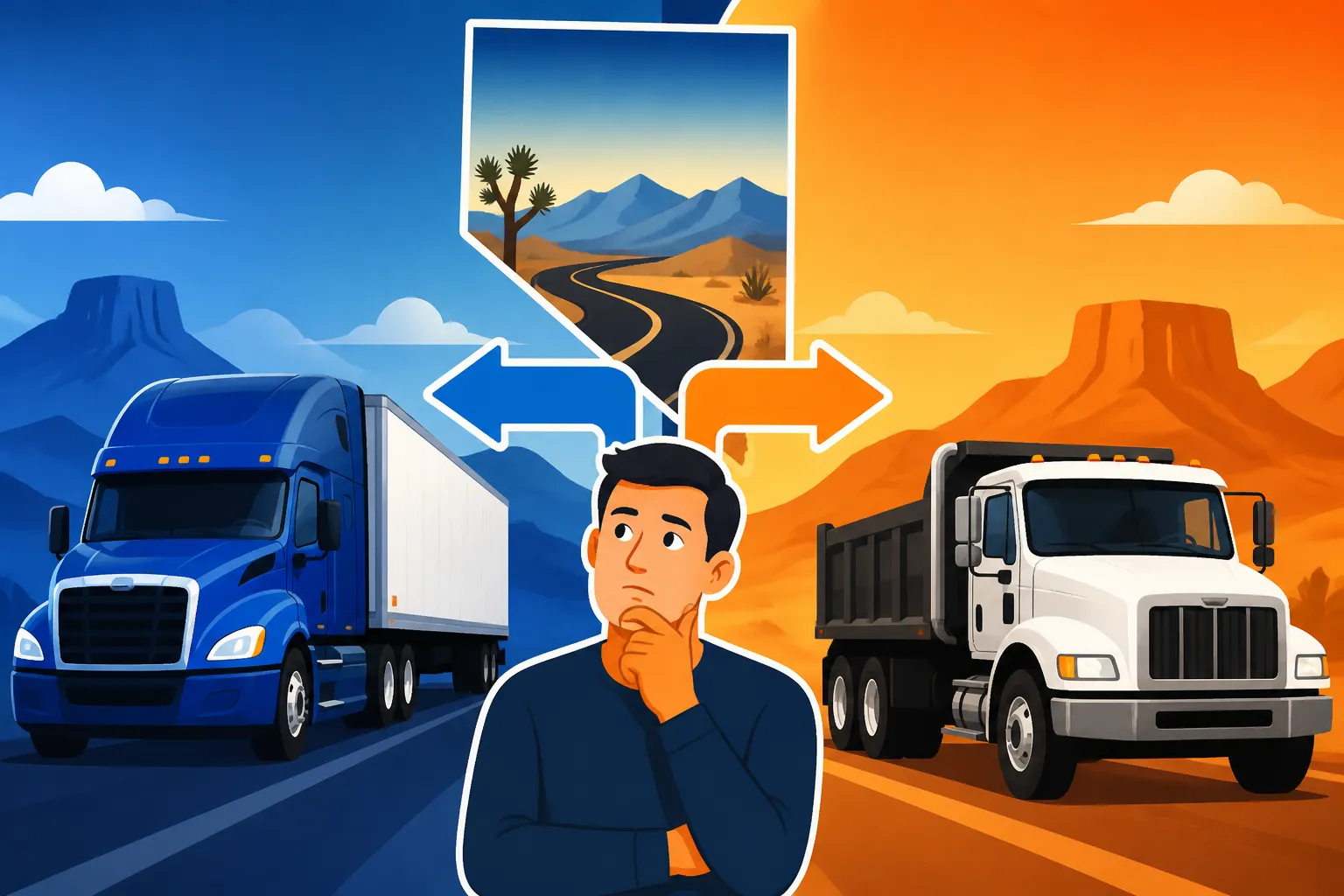
A commercial driver’s license and a noncommercial Class A or B license are not interchangeable labels for “a big vehicle.” The right credential depends on the kind of vehicle and operation involved. Start by identifying what you will drive, how it is configured, and whether the vehicle is being used in a commercial capacity. Then check the applicable Nevada DMV requirements rather than assuming that a heavy vehicle automatically requires a CDL.
For a vehicle used commercially, begin with the Nevada DMV’s commercial licensing information and determine whether a CDL applies to your situation. Starting Out With a Commercial Driver’s License in Nevada covers the commercial-license path. If the vehicle is an RV, boat, or trailer used outside a commercial operation, check the noncommercial heavy-license rules as well; those rules can call for a noncommercial Class A or B.
The distinction matters because the word “Class A” can appear in both commercial and noncommercial licensing contexts. Seeing that class name on a form or in a handbook does not by itself tell you whether the commercial or noncommercial route applies. You need to match the license type to your use case.
A practical way to begin is to write down the answers to these questions:
- What vehicle will you operate?
- Will it tow another vehicle or trailer?
- What are the vehicle’s manufacturer weight ratings?
- Is the vehicle part of a commercial operation, or is it being used for a personal purpose?
- Does the Nevada DMV identify a noncommercial Class A or B as the applicable license for your situation?
Those questions help narrow the research, but they do not replace the DMV’s determination. A vehicle’s actual load, the way it is used, and the relationship between a towing vehicle and the vehicle behind it can all affect which requirements you need to verify.
| Situation to check | What to examine | Useful starting point |
|---|---|---|
| Heavy single vehicle | The vehicle’s GVWR and whether the vehicle is used commercially | Nevada DMV’s Class B and CDL information |
| Combination vehicle | The ratings for the combination and the vehicle being towed | Nevada DMV’s Class A and CDL information |
| RV, boat, or trailer for personal use | Whether the noncommercial heavy-license requirement applies | Noncommercial Class A for RVs and Trailers Over 26,001 Pounds |
| Unclear rating or combination | The manufacturer ratings and vehicle documents, not just the scale weight | GVWR, GCWR or Actual Weight? What Sets Your License Class |
| Firefighter, farmer, or military operator | Whether a limited exemption may apply to the specific operation | Endorsement F, the CDL Exemption for Farmers and Firefighters |
Treat the table as a way to organize your questions, not as a substitute for checking the agency’s rules. If any detail is uncertain, confirm it with the Nevada DMV before driving or beginning a licensing application.
When Nevada’s noncommercial Class A or B applies
Nevada’s noncommercial Class A and Class B rules are especially relevant to people who need to operate a heavy RV, boat, or trailer without pursuing a commercial license. According to the Nevada DMV, drivers of RVs, boats, and trailers weighing 26,001 pounds or more must possess a non-commercial Class A or B license.
That requirement is about the noncommercial credential. It does not mean that every person driving a heavy vehicle needs the same license, nor does the vehicle’s size alone settle whether a CDL is required. First determine whether your situation falls under the noncommercial rule or needs to be assessed under commercial licensing requirements.
The Nevada DMV describes the class thresholds by vehicle configuration and weight rating. According to the Nevada DMV, a Class A license covers combination vehicles with a GCWR of 26,001 pounds or more, provided the vehicle being towed has a GVWR of 10,001 pounds or more. According to the Nevada DMV, a Class B driver license permits operating single vehicles with a GVWR of 26,001 pounds or greater.
These descriptions point to different kinds of vehicles:
- Class A: A combination of vehicles, where the combined rating and the rating of the towed vehicle are relevant.
- Class B: A single vehicle, where the vehicle’s GVWR is relevant.
- Commercial or noncommercial: A separate question about the license route that applies to your operation.
That last distinction is important. The class thresholds do not, by themselves, tell you whether to apply for a CDL or a noncommercial license. Use them to identify which vehicle category may be relevant, then verify the commercial or noncommercial licensing requirements with the Nevada DMV.
For a personal RV or trailer, read Is a CDL Required to Drive a Heavy RV for Personal Use in Nevada? alongside the noncommercial Class A or B rules. That can help clarify the question you are trying to resolve, but the Nevada DMV remains the authority on the credential required for your specific vehicle and use.
It is also easy to focus only on the towing vehicle. With a combination, the tow vehicle and the vehicle behind it form part of the licensing picture. A motorhome pulling a trailer, for example, should not be assessed solely by looking at the motorhome’s own rating. Similarly, a heavy single vehicle should not be treated as a combination just because it is large or carries a load.
When the Nevada DMV says that drivers of RVs, boats, and trailers weighing 26,001 pounds or more must possess a non-commercial Class A or B license, do not assume that “Class A or B” means you can choose either class at will. The appropriate class depends on the vehicle and its configuration. Confirm which one fits your specific setup before planning a test or submitting paperwork.
Read the weight ratings before choosing a class
The numbers printed on vehicle documents can be more useful than a guess based on how heavy a vehicle looks or feels. In particular, distinguish the manufacturer’s weight ratings from the vehicle’s actual weight on a given day. A vehicle may be lightly loaded and still have a high rated capacity, so actual scale weight alone may not answer the licensing question.
The Nevada DMV’s Class A description uses the GCWR, or gross combination weight rating, together with the GVWR, or gross vehicle weight rating, of the towed vehicle. The Class B description refers to the GVWR of a single vehicle. If you are not sure which rating applies to your setup, begin with the vehicle documents and use GVWR, GCWR or Actual Weight? What Sets Your License Class to sort out the terms.
Look for the manufacturer’s labels and paperwork for both the vehicle doing the towing and the vehicle being towed. Depending on the setup, relevant information may appear on a vehicle certification label, owner’s manual, specification sheet, or other manufacturer documentation. If the available documents conflict or you cannot find a rating, ask the vehicle manufacturer or dealer how to identify it, then confirm with the Nevada DMV how the rating is used for licensing.
For a combination vehicle, do not rely on only one rating. The Nevada DMV’s Class A rule refers both to the combination’s GCWR and to the towed vehicle’s GVWR. A large tow vehicle does not automatically establish the class on its own; the towed unit matters too.
For a single vehicle, begin with its GVWR. According to the Nevada DMV, a Class B driver license permits operating single vehicles with a GVWR of 26,001 pounds or greater. That is not the same test as the Class A combination rule. If your vehicle is a single unit, comparing its GVWR with the Nevada DMV’s Class B description is a more relevant starting point than trying to apply the combination-vehicle threshold.
A few common errors can send drivers toward the wrong license:
- Using actual scale weight as a substitute for a rating. Actual weight can change with passengers, cargo, fuel, or equipment. The Nevada DMV’s class descriptions refer to rated weights, so locate the stated ratings rather than relying only on a weigh scale.
- Checking only the tow vehicle. For a combination, the towed vehicle’s rating is part of the Class A description.
- Treating a trailer’s empty weight as its GVWR. Those figures describe different things. Find the manufacturer’s rating instead of assuming the empty weight is the licensing figure.
- Assuming “personal use” resolves every question. Personal use may point you toward noncommercial requirements, but you still need to identify the correct class and confirm the rules for your configuration.
- Treating the letters of the class as enough information. Commercial and noncommercial licenses can involve different requirements even when a class letter is shared.
If your vehicle is close to a threshold, the practical approach is not to round or estimate. Find the ratings on the vehicle documents and ask the Nevada DMV how they apply to your exact setup. Keep the information available when you contact the agency or prepare for a licensing transaction.
How to choose the right licensing route
The most efficient way to avoid a wrong turn is to decide which question you are answering first: whether your operation requires a CDL, or whether a noncommercial heavy license applies. Then gather the vehicle details that support that decision.
Use this process:
- Describe the use. Note whether the vehicle is for personal use or part of a commercial operation. Do not assume that one detail settles the license requirement; use it to identify which DMV rules to review.
- Describe the configuration. Identify whether you will drive a single vehicle or a combination that includes a towed vehicle.
- Find the ratings. Locate the GVWR for a single vehicle, or the relevant combination and towed-vehicle ratings for a combination. Avoid substituting actual loaded weight for a manufacturer rating.
- Compare the setup with Nevada DMV descriptions. The Class A and Class B descriptions use different vehicle configurations and rating terms.
- Check for a special provision. If you are a firefighter, farmer, or military operator of noncommercial heavy equipment, ask whether Endorsement F applies to your operation.
- Confirm the credential and next steps with the Nevada DMV. Ask what class and license type fit your situation before booking a test or completing an application.
If the vehicle is being used commercially, the Nevada DMV’s CDL information is the appropriate place to confirm the requirements and steps. Training, Permit and Paperwork to Line Up Before Nevada CDL Tests can help you organize questions about preparation, but the Nevada DMV determines the applicable licensing rules and transactions. Commercial licensing may involve requirements beyond identifying a vehicle class, so do not use a noncommercial Class A or B handbook as a complete substitute for CDL-specific instructions.
If the use is noncommercial, the Nevada DMV offers an English Class A & B and J Endorsement handbook for non-commercial licenses in English. Use the official handbook as the main study reference for the noncommercial route. The DMV’s licensing guidance and handbook help you confirm what applies; make sure you are reading material for the license type you actually need.
A private study service such as I Drive Safely may be useful as an additional way to organize study, but check that any material you use matches the Nevada DMV’s noncommercial Class A or B requirements. A general study resource should not override the state handbook or answer the vehicle-class question for you.
If you are unsure whether your vehicle crosses a threshold, prepare a concise description before asking for help. Include the vehicle type, whether it is towing anything, the relevant ratings, and whether the use is commercial or personal. A specific question is more likely to get you a useful answer than asking simply, “Do I need a heavy license?”
For a broader overview of Nevada license categories, see Nevada License Classes A, B, C and M and Their Endorsements. If your question is specifically about a large RV or trailer, How Much RV or Trailer Does a Regular Class C License Cover? may also help you identify what needs confirmation. For the noncommercial heavy vehicle route, Noncommercial Class A for RVs and Trailers Over 26,001 Pounds is the more focused reference.
Endorsement F and situations that need extra confirmation
Some drivers are not choosing between an ordinary CDL route and an ordinary noncommercial route. The Nevada DMV says Endorsement F provides a limited exemption from standard CDL requirements for firefighters, farmers, and military operating non-commercial heavy equipment.
The word “limited” matters. Do not treat Endorsement F as a blanket exemption for every person in those occupations, every heavy vehicle, or every kind of use. Confirm with the Nevada DMV whether the specific operator, vehicle, and activity meet the applicable conditions. If the equipment is being used in a way that differs from the situation covered by the exemption, do not assume the same exception applies.
Endorsement F is also distinct from a noncommercial Class A or B. It relates to a limited exemption from standard CDL requirements; it does not mean every qualifying operator should skip checking the noncommercial class rules. Depending on the vehicle and operation, you may need to understand how the exemption and the class requirements fit together. The Nevada DMV can clarify which credential or endorsement is relevant.
The same caution applies when a vehicle has been modified, is used by an organization, or serves both personal and work purposes. A driver may think of the trip as personal, while the vehicle’s role or the operation raises a licensing question that needs official confirmation. Be clear about the actual use, not only who owns the vehicle.
When speaking with the Nevada DMV, it may help to ask focused questions such as:
- Does the vehicle fall under the noncommercial Class A or B description?
- Is the operation treated as commercial for licensing purposes?
- Does Endorsement F apply to this operator and equipment?
- Which official handbook or instruction applies to this license route?
- What must be completed before the driver can legally operate the vehicle?
Those questions keep the discussion centered on the facts that matter. They also help avoid a common mistake: preparing for a test or application before confirming which license type is appropriate.
Before you drive, keep your vehicle documents and any relevant licensing records organized. If you are comparing more than one possible setup—for example, different trailers or equipment configurations—record the ratings for each one separately. A conclusion that applies to one vehicle combination may not apply to another.
Frequently Asked Questions
Does a heavy personal RV automatically require a CDL?
Not necessarily. The Nevada DMV says drivers of RVs, boats, and trailers weighing 26,001 pounds or more must possess a non-commercial Class A or B license. Confirm the class that fits the vehicle and use with the Nevada DMV; do not assume that a heavy personal vehicle automatically requires a CDL.
What is the difference between Class A and Class B?
According to the Nevada DMV, Class A covers combination vehicles with a GCWR of 26,001 pounds or more, provided the vehicle being towed has a GVWR of 10,001 pounds or more. According to the Nevada DMV, Class B permits operating single vehicles with a GVWR of 26,001 pounds or greater.
Can I use actual vehicle weight to decide which class applies?
Do not rely on actual loaded weight alone. The Nevada DMV’s Class A and Class B descriptions use weight ratings. Find the manufacturer’s ratings for the vehicle and, when applicable, the vehicle being towed, then confirm how they apply to your configuration.
Does Endorsement F exempt every firefighter or farmer from CDL requirements?
No. The Nevada DMV describes Endorsement F as a limited exemption from standard CDL requirements for firefighters, farmers, and military operating non-commercial heavy equipment. Confirm whether the exemption covers the particular operator, equipment, and use.
Sources
- Nevada DMV — Nevada DMV DL (checked November 12, 2026)
- Nevada DMV — Nevada DMV – DMV Handbooks & Resources (checked November 12, 2026)
Disclaimer
This article is for general informational purposes only and does not constitute professional advice. Laws, prices and regulations vary by location and change over time. Consult a qualified professional for guidance on your specific situation. Nevada Driver Guide is not a government agency and is not affiliated with any state motor vehicle department.