A New Resident’s Document Checklist for a Nevada Driver’s License
Moving to Nevada means more than changing your address: you also need a document packet that supports your identity, Social Security information and Nevada residence. The tricky part is bringing the right kind of proof, especially for your street address or a name change. Use this checklist to organize your records and confirm what the Nevada DMV accepts before your visit.
Start with the core document packet
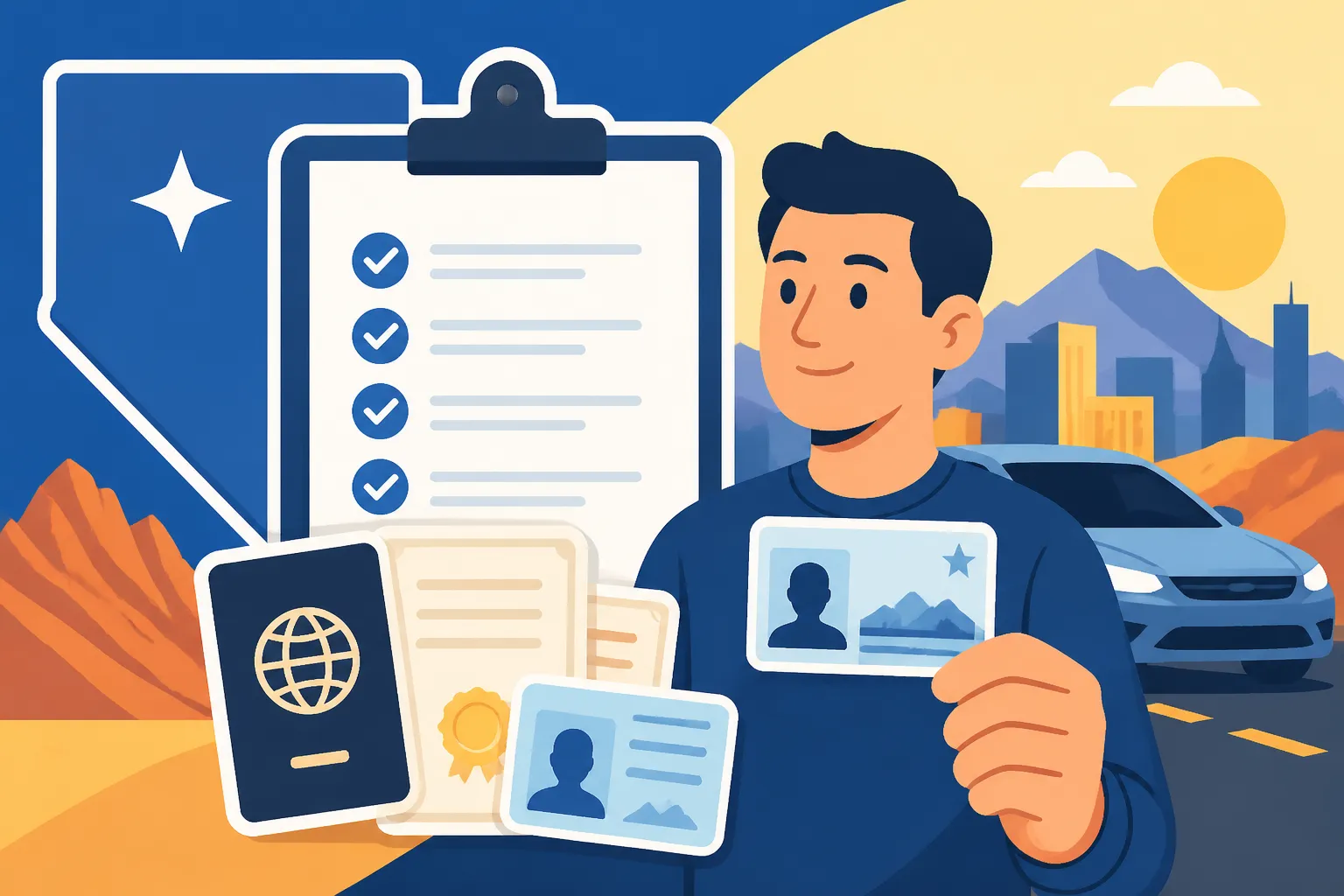
According to the Nevada DMV, new Nevada residents should bring their current out-of-state license, proof of identity, proof of Social Security, and two documents showing their Nevada residential address. Think of these as separate parts of the packet: having a license from another state does not mean you can skip checking the requirements for the other categories.
A typical driver license or ID transfer requires two proofs of Nevada residential address, according to the Nevada DMV. The agency also says applicants must present two documents verifying their Nevada residential address. Because address evidence is a common sticking point, gather it deliberately rather than relying on a single document that seems likely to qualify.
Use this checklist to organize what you have:
- Current out-of-state license: Bring the license you currently use, if you have it. If it is missing, expired or otherwise not straightforward, check the Nevada DMV’s instructions for your situation before your visit.
- Proof of identity: The Nevada DMV gives an original birth certificate or passport as basic examples. Check the agency’s document list for other accepted proofs and for any requirements about the document’s format.
- Proof of Social Security: Prepare the evidence the Nevada DMV accepts for this category. Do not assume that a document showing your name or address also satisfies the Social Security requirement.
- Two Nevada residential address documents: Select two separate documents that the Nevada DMV accepts for your situation. Review the accepted-document list instead of relying on a document type simply because it displays your name and address.
- Name-change records, if applicable: If the name on your identity document differs from the name you use now, check whether you need proof connecting the names.
- Translations, if applicable: If a document is not in English, check the Nevada DMV’s translation requirements before your visit.
The exact document list matters more than a document’s general category. A bill, statement or record may look useful but still not meet the agency’s rules for the particular transaction. The Nevada DMV’s list is the place to confirm whether a specific item qualifies, including whether it must be original, current, certified or presented in a particular form.
For a broader breakdown of evidence types, see Which Documents Count as Proof of Identity and Nevada Residency?. If a record you plan to use is not clearly covered, confirm it with the Nevada DMV rather than making a last-minute guess.
Keep the categories distinct
It helps to sort documents into separate piles or labeled sleeves: identity, Social Security, address and name-change evidence. That simple organization makes it easier to spot a missing category before leaving home.
A single document might appear relevant to more than one requirement, but do not assume it can satisfy multiple categories. Check how the Nevada DMV classifies each document. For instance, a document that establishes identity may not be accepted as proof of a Nevada residential address, and an address record may not establish identity.
Also compare names across the records you plan to bring. This is a practical check, not a substitute for the Nevada DMV’s rules: a mismatch can make it harder to explain how documents relate to one another. If your legal name changed, gather the official records that connect the names and check the required sequence of evidence with the agency.
Check the exact version of every record
Before you pack, inspect each document rather than relying on memory. Confirm that the name, address and other identifying details are readable. If a document is damaged, incomplete or difficult to interpret, ask the Nevada DMV whether it is acceptable before counting on it.
Do not alter or write on an official record to make it appear to meet a requirement. If a record contains an old address or a former name, find out whether the Nevada DMV accepts it alongside other evidence or whether you need a different document.
Choose address evidence carefully
Address proof deserves its own review because it is not enough to bring only a Nevada mailing address. According to the Nevada DMV, an applicant for a Nevada driver license must live at a Nevada street address rather than a P.O. Box. The agency also requires two proofs of a Nevada residential address for a driver license transfer.
Start by writing down the street address where you live and comparing it with the address shown on each potential document. A practical goal is to make the address easy to read and consistent across the records you present. If the documents use different versions of the address, such as an abbreviated street name on one record, check whether the Nevada DMV will accept them.
Do not treat a P.O. Box as a replacement for the residential street address. If you use a P.O. Box for mail, check the Nevada DMV’s current instructions for how to provide the residential address and whether a separate mailing address can also be recorded. The key point is that a P.O. Box alone does not satisfy the street-address requirement.
The Nevada DMV’s accepted-document list should guide your choice of address records. It can be tempting to bring whatever paperwork is easiest to find, but a document needs to fit the agency’s requirements, not merely show that you receive mail in Nevada. Review Bills, Leases and Records That Work as Two Proofs of Nevada Address for help thinking through common address-document questions, then confirm the eligibility of your specific records with the Nevada DMV.
If you are staying with someone else
A recent move does not always come with a lease or utility account in your own name. If you are staying with family, a roommate or another host, do not assume that their documents automatically prove your residence. Check the Nevada DMV’s list and instructions for applicants whose address evidence is not in their own name.
Before visiting, ask the person you live with what records are available and compare them with the Nevada DMV’s accepted options. If the agency requires a specific affidavit or supporting document for your situation, find the current form and instructions through the official agency. Do not rely on an informal letter unless the Nevada DMV says it is acceptable.
If you are in temporary lodging or an RV park, the same principle applies: confirm what evidence the Nevada DMV accepts for your actual living arrangement. No Lease? Proving Nevada Residency While Staying With Family and Proving Residency From a Hotel, RV Park or Campground Stay cover situations where conventional address paperwork may be difficult to provide.
Use two eligible documents, not one strong document
The requirement is not simply to prove that you have moved. According to the Nevada DMV, a driver license transfer requires two proofs of a Nevada residential address. A document that feels especially convincing may still leave the packet incomplete if you have only one accepted address proof.
Choose two documents that each meet the Nevada DMV’s criteria. If you are unsure whether two records are separate qualifying proofs, check the agency’s list or ask the Nevada DMV before your appointment. The titles of documents can be misleading: two papers from the same company are not automatically two acceptable proofs, and two documents that show an address are not automatically accepted.
When comparing options, look for records that clearly display the details the DMV expects and that fit its list. Avoid making a final selection based only on convenience or on advice meant for another state. Nevada’s requirements are the ones that apply to a Nevada license transaction.
Decide whether you are applying for a standard license or REAL ID
A move to Nevada is a good time to decide which license option you want, because the documentation packet may differ. A standard license and a REAL ID do not have identical document checklists. Review Nevada REAL ID vs. Standard License: Which One Fits Your Life? if you are deciding which credential suits your needs, and A Complete Driver’s Guide to REAL ID in Nevada for a fuller explanation.
For a Nevada REAL ID, the Nevada DMV requires Proof of identity (one document), Proof of all name changes (if applicable), Proof of Social Security Number (one document), Two Proofs of Nevada Residential Address, DMV Approved Translation(s). These categories are worth checking separately before you go.
That means a REAL ID packet should account for:
- Identity: Select one accepted identity document from the Nevada DMV’s list.
- Name changes: Include proof of all name changes if applicable. If the name on your identity record differs from your current legal name, gather the documents that connect them and verify that they meet the agency’s requirements.
- Social Security Number: Select one accepted proof from the Nevada DMV’s list.
- Nevada residential address: Prepare two accepted address proofs.
- Translations: Arrange DMV-approved translations for any non-English documents.
A REAL ID checklist can be more involved when records use different names or include documents in another language. Do not leave those details to the day of your visit. Check the Nevada DMV’s accepted identity and name-change documents, and confirm that any translations meet its approval rules. For issues with a name that changed after marriage, Name Changed After Marriage? Proving It for a Nevada REAL ID may help you identify the documents to review.
A standard license also has documentation requirements. Choosing the standard option does not remove the need to establish identity and Nevada residency. According to the Nevada DMV, all first-time applicants for a Nevada driver license, ID card, or Driver Authorization Card must provide proof of identity and residency. The exact checklist for your transaction should come from the Nevada DMV.
If you are not sure which option you want, compare the purpose of each credential before collecting documents. The aim is to avoid building a packet for one credential and arriving expecting to receive another. You can also check the Nevada DMV’s current instructions for how to select the credential during the transaction.
Handle name differences and non-English records before your visit
Names can differ across documents for ordinary reasons: marriage, divorce, adoption, a legal name change, or different spellings or formats across records. The important preparation step is to identify those differences before you go and check what evidence the Nevada DMV requires to connect them.
For a REAL ID, the Nevada DMV requires proof of all name changes if applicable. If your current name does not match the name on your identity document, gather the legal records that establish the change and confirm that the Nevada DMV accepts them. Do not assume that one record showing your current name will explain every earlier name.
Make a simple name trail for yourself as you prepare. Write down the name shown on each document and note which official record explains any change. This is an organizational aid, not a substitute for the required evidence. If the chain is not clear from the documents you have, ask the Nevada DMV what it needs before you travel to an office.
Non-English records need the same advance attention. For a REAL ID, the Nevada DMV lists DMV-approved translations for any non-English documents. Do not assume that a translation completed by any person or service will meet the agency’s approval rules. Check the Nevada DMV’s instructions for the required translator credentials and the way translated documents must be presented.
If your identity documents are difficult to classify, Identity Documents the DMV Accepts and Rejects for a First REAL ID can help you focus your review. For broader questions about copies, originals and translations, see Nevada DMV Rules on Copies, Certified Originals and Translations. Verify the current requirements with the Nevada DMV, especially when your records are from outside the United States or use a name different from your current one.
Make a final check before going to the DMV
A little preparation can prevent a visit that ends with a missing document or an unclear address proof. Use the Nevada DMV’s official document list as your final reference and review your packet against the transaction you intend to complete.
Before you leave:
- Confirm that you have your current out-of-state license, if you have one.
- Check the accepted identity evidence for your application.
- Confirm that you have the accepted proof of Social Security.
- Verify that each of your two address documents qualifies and shows your Nevada residential address.
- Check whether you need name-change records.
- Confirm translation requirements for any non-English document.
- Look for differences in names or addresses and bring the records that explain them.
- Keep related papers together so you can present each category clearly.
- Check the Nevada DMV’s current instructions for the transaction and the office you plan to visit.
These are preparation steps, not a guarantee that every document will be accepted. The Nevada DMV makes the decision based on its rules and the documents you present. If an item is uncertain, ask the agency before relying on it.
A move can involve both a license transfer and other tasks, so make sure you are checking the correct procedure. The Driver’s License Transfer Guide for People Moving to Nevada explains the broader transfer process, while Common Document Mistakes When Switching to a Nevada License can help you catch paperwork problems. If you need to plan an office visit, review What to Bring to a Nevada DMV Appointment, Errand by Errand and use the Nevada DMV’s official office locator to find the nearest office and its current hours.
If your out-of-state license is lost, your name has changed, or your residency records do not fit the standard examples, do not rely on a generic checklist alone. Describe your situation to the Nevada DMV and ask which documents apply to your transaction. A short check before the visit is usually easier than discovering that a key record is missing at the counter.
Frequently Asked Questions
Do I need two proofs of Nevada address to transfer my license?
Yes. According to the Nevada DMV, a driver license transfer requires two proofs of a Nevada residential address. Check the agency’s document list to confirm that each document you plan to use qualifies.
Does a P.O. Box count as my Nevada residential address?
No. According to the Nevada DMV, an applicant for a Nevada driver license must live at a Nevada street address rather than a P.O. Box. Check the agency’s instructions if you also use a P.O. Box for mail.
What identity documents can I bring?
The Nevada DMV gives an original birth certificate or passport as basic examples of proof of identity. Check the agency’s document list for other accepted proofs and any requirements about the document’s format.
What extra documents may a REAL ID require?
For a REAL ID, the Nevada DMV requires one proof of identity, proof of all name changes if applicable, one proof of Social Security Number, two proofs of Nevada residential address, and DMV-approved translations for any non-English documents.
Sources
- Nevada DMV — Nevada DMV – Frequently Asked Questions (checked November 12, 2026)
- Nevada DMV — Nevada DMV (checked November 12, 2026)
- Nevada DMV — Nevada DMV (checked November 12, 2026)
- Nevada DMV — Nevada DMV (checked November 12, 2026)
- Nevada DMV — Nevada DMV (checked November 12, 2026)
Disclaimer
This article is for general informational purposes only and does not constitute professional advice. Laws, prices and regulations vary by location and change over time. Consult a qualified professional for guidance on your specific situation. Nevada Driver Guide is not a government agency and is not affiliated with any state motor vehicle department.