Just Moved to Nevada? The 30-Day Deadline to Switch Your License
Moving to Nevada brings a practical licensing question: when does the deadline start, and what should you prepare before handling the transfer? The answer depends on establishing residency, not simply on when you find time for an appointment. Here’s how to understand the deadline, organize your documents, and avoid preventable delays while working with the Nevada DMV.
When the 30-day deadline starts
According to the Nevada DMV, new residents moving from another state must apply for a Nevada driver’s license within 30 days after becoming a resident. The Nevada DMV also describes the deadline as within 30 days of establishing residency. In practical terms, treat the point when you establish Nevada residency as the start of the clock—not the date you happen to book an appointment or begin gathering paperwork.
That distinction matters if your move unfolds in stages. You might arrive with temporary housing, move your belongings later, or spend time arranging work and services before everything feels settled. The facts that matter for your own situation are whether and when you became a Nevada resident. If you are uncertain about that date, ask the Nevada DMV how it applies the residency rule to your circumstances rather than assuming the deadline starts only after a lease, job, or other single milestone.
| Question | What to keep in mind |
|---|---|
| Who does the deadline apply to? | New Nevada residents moving from another state who need to apply for a Nevada driver’s license. |
| When does the clock start? | The Nevada DMV says the deadline is within 30 days after becoming a resident or establishing residency. |
| What address paperwork is typical for a transfer? | The Nevada DMV says a typical driver license or ID transfer requires Two Proofs of Nevada Residential Address. |
| What if you are unsure whether you qualify as a resident? | Ask the Nevada DMV how the rule applies to your move and when it considers residency established. |
The deadline is a reason to plan promptly, but it is not a reason to guess. A person who has not yet figured out which documents to bring may be better served by checking the official requirements first than by making an unprepared trip. On the other hand, waiting until the end of the window to start researching can leave little room to replace a missing record or resolve a mismatch.
If you are moving with a valid out-of-state license, do not assume that it gives you more time than the new-resident rule allows. The Nevada DMV’s stated deadline still applies to new residents moving from another state. For a closer look at how the old license fits into this period, see Driving on Your Old License During Nevada’s 30-Day New Resident Window.
The deadline is about applying for a Nevada license. It does not mean that every new resident’s transfer will follow an identical path. What documents are needed, whether testing is required, and how to complete the transaction can depend on your circumstances. Use the time window to confirm your own requirements with the Nevada DMV and prepare for the application, rather than relying on someone else’s transfer experience.
Prepare your address and identity documents
For a typical driver license or ID transfer, the Nevada DMV requires Two Proofs of Nevada Residential Address. That is the key document-preparation point to address early. “Two proofs” does not mean you should bring two copies of the same document or assume that anything showing a Nevada address will qualify. Confirm which documents the Nevada DMV accepts and whether they meet its current rules for your particular transfer.
An address record also needs to be useful for the transaction. Check that the name and residential address are readable and consistent with the information you plan to provide. If you recently moved, some records may still show your former address. If you are staying with family or do not have a lease in your name, do not rely on an informal assumption that your situation is automatically covered. Find out what documentation the Nevada DMV accepts for your living arrangement before you go.
For help identifying possible records, review Which Documents Count as Proof of Identity and Nevada Residency? and Bills, Leases and Records That Work as Two Proofs of Nevada Address. These references can help you think through what you have, but the Nevada DMV is the authority on which documents it will accept for your transaction. Check the official requirements before relying on a particular record.
Make a document check before booking
Gather the records you may need and compare them with the Nevada DMV’s official document requirements. Verify that the documents belong to you or otherwise satisfy the agency’s rules, show the required information, and are in an acceptable form. If you have a name difference between records, a document that is hard to read, or a proof that has not yet been updated to your Nevada address, ask how to handle it before your visit.
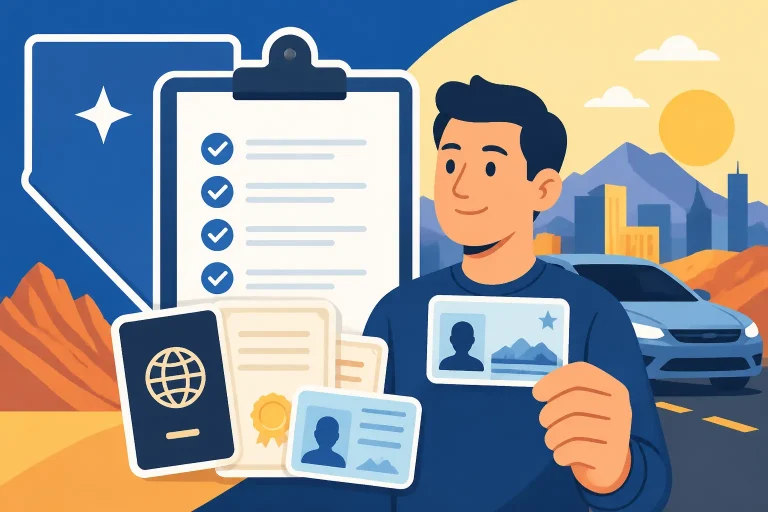
It can help to keep a short personal checklist:
- Proofs of Nevada residential address that the Nevada DMV accepts for your situation
- Identity documents required for the type of license or ID you are applying for
- Your current out-of-state driver’s license, if you have one
- Any additional records the Nevada DMV says apply to your case
This is a planning checklist, not a promise that those items alone will complete every application. The Nevada DMV may require different or additional documentation based on the details of your transfer. For a broader preparation list, use A New Resident’s Document Checklist for a Nevada Driver’s License. If a document has been rejected before or you are not sure whether a copy is enough, Common Document Mistakes When Switching to a Nevada License may help you spot questions to resolve in advance.
If you are still settling into housing
A move does not always begin with a long-term lease in the new resident’s name. You might be staying with relatives, using temporary accommodation, or waiting for household records to change. That can make the address-proof requirement feel like the hardest part of a transfer.
Avoid creating a document based on what you think should be acceptable. Instead, describe your living arrangement accurately when checking the Nevada DMV’s requirements and ask what evidence it accepts. If you are staying with family, see No Lease? Proving Nevada Residency While Staying With Family. If you are in temporary accommodation, Proving Residency From a Hotel, RV Park or Campground Stay may be relevant. Neither situation should be treated as automatically approved or automatically disqualified without checking the rules that apply to you.
The address requirement is separate from the question of when you became a resident. Do not assume that your deadline starts only when you have two completed proofs in hand. The Nevada DMV states that the deadline is within 30 days after becoming a resident or establishing residency, while a typical transfer requires Two Proofs of Nevada Residential Address. If the date of residency and the timing of your documents do not line up neatly, contact the Nevada DMV promptly to ask how to proceed.
Plan the transfer with the Nevada DMV
Once you have a clear sense of your documents, confirm the steps for your license transfer directly with the Nevada DMV. The agency handles applications, and the requirements can vary with your driving history, license status, and other details. Do not treat a general checklist—or another driver’s experience—as a substitute for confirming the requirements for your own case.
A practical order of operations is:
- Identify the date you believe you established Nevada residency. If you are unsure how the Nevada DMV will interpret your circumstances, ask the agency rather than choosing a date based only on convenience.
- Check the Nevada DMV’s current instructions for new residents transferring an out-of-state license.
- Confirm which identity records and Two Proofs of Nevada Residential Address are acceptable for your situation.
- Find out whether your transfer requires any tests or other steps. The answer can depend on your circumstances; the Nevada DMV’s guidance is the place to verify it. For background, see Which Tests Do New Nevada Residents Take to Transfer a License?.
- Follow the Nevada DMV’s instructions to complete the application, arrange any required visit or testing, and provide the requested documents.
The process may involve an in-person visit, testing, or other steps depending on the Nevada DMV’s requirements for your case. Do not assume a service is available online or that an appointment is optional. Check the agency’s current instructions before choosing how to complete the transaction. If a visit is required, use the official agency’s office locator to find a nearby office and confirm its current hours. The Nevada DMV is where you complete the application and any required payment, appointment, or test booking.
If you want to understand the broader transfer process before preparing a visit, read The Driver’s License Transfer Guide for People Moving to Nevada. If you are also working out which appointment category fits your task, Out-of-State License and Plates: Which Nevada Appointment Type to Book can help you identify what to confirm with the agency. A wrong appointment choice or incomplete paperwork can cost time, so check the Nevada DMV’s current instructions rather than relying on an old confirmation or another person’s description of the process.
For drivers who are also handling vehicle paperwork, keep license and vehicle transactions conceptually separate. A driver’s license transfer and vehicle registration are different tasks, and the requirements may not line up exactly. If you are registering an out-of-state vehicle too, see Registering Your Out-of-State Vehicle as a New Nevada Resident and confirm each transaction with the Nevada DMV. Do not assume that completing one automatically completes the other.
Avoid delays and handle complications early
The most useful way to protect the deadline is to avoid waiting until the last moment to learn what your transfer requires. A missing proof of address, an unclear document, or uncertainty about testing can all take time to resolve. Start with the date residency began, then work through the document and procedure questions while there is still time to respond if something is missing.
Common planning mistakes
Counting from the wrong event. The Nevada DMV’s deadline is within 30 days after becoming a resident or establishing residency. Do not automatically count from the date you sign a lease, receive a bill, or book an appointment unless that is also when you established residency under the circumstances of your move. If you cannot tell when the deadline began, ask the Nevada DMV how it applies the rule.
Assuming two similar-looking papers will qualify. The Nevada DMV says a typical transfer requires Two Proofs of Nevada Residential Address. Confirm the accepted document types and whether your records satisfy the agency’s requirements. Do not assume that two copies, two records from the same source, or records showing different addresses will work.
Leaving identity documents until the end. Address evidence is important, but it may not be the only paperwork involved. Check the identity requirements for the license or ID you are seeking. Which Documents Count as Proof of Identity and Nevada Residency? can help you organize questions, while the Nevada DMV’s instructions determine what is accepted.
Assuming a valid out-of-state license settles every question. An existing license does not remove the need to check the new-resident application process or the 30-day deadline. If you have a restriction, an unusual license status, or a gap in your driving history, ask the Nevada DMV whether it changes the steps you must take.
Waiting for every household record to update before asking for help. A newly moved resident may not yet have every bill or account reflecting a Nevada address. Do not assume you must wait, and do not assume an older or temporary record will qualify. Ask the Nevada DMV what it accepts for your circumstances and what to do if a document is not yet available.
Treating an appointment as the same thing as applying. A scheduled visit is not a substitute for completing the application process with the Nevada DMV. The agency’s stated deadline is tied to becoming or establishing residency, not to when you reserve a time. If you are worried about getting a visit or required step arranged in time, contact the Nevada DMV promptly and follow its instructions.
If you are close to the deadline
If you have already established residency and are approaching the end of the deadline, focus on the unresolved issue that could block your application. That might be confirming acceptable address proofs, learning whether testing applies, or finding the right way to complete the transaction. Contact the Nevada DMV directly and explain the situation clearly. Ask what action you need to take and what records to bring.
Do not rely on a friend’s account of how long an application took or assume that a particular office will accept a walk-in. Procedures and service availability can change, and your needs may differ from another driver’s. Use the Nevada DMV’s official instructions and office locator to check the appropriate route and current office information.
If your old license is close to expiring, suspended, or otherwise not in ordinary standing, mention that when seeking guidance. A transfer is not necessarily the same for every driver, and the answer may depend on your record. For a general discussion of transfer testing, see Which Tests Do New Nevada Residents Take to Transfer a License?, then verify your own requirements with the Nevada DMV.
If you have already missed the window, do not assume that ignoring the issue will make it go away or that you can resolve it by continuing to use your former license indefinitely. Contact the Nevada DMV, explain when you moved and what you have done so far, and ask what the agency requires next. The right next step depends on your circumstances; avoid making a decision based on guesswork.
Keep the move manageable
A license transfer is easier to handle when it is treated as a defined task rather than one item in a long, unstructured moving checklist. First establish when you became a Nevada resident. Next confirm the Nevada DMV’s current document and application requirements. Then arrange any required steps with enough time to address a missing record or an unexpected requirement.
A simple folder—physical or digital—can help keep the paperwork together. Store the records you plan to use, notes about questions you asked, and any appointment or application details supplied by the Nevada DMV. Keep originals or other required forms in the format the agency specifies; do not assume a photograph, scan, or copy is acceptable unless the Nevada DMV says it is.
If you have more than one Nevada DMV task, identify what is needed for each. A license transfer, a vehicle registration, and a change to an existing record may have separate requirements. For help sorting online and in-person tasks, Online or In Person? Sorting Nevada DMV Tasks Before You Book offers a useful way to think through what to verify. Confirm the actual process with the Nevada DMV before traveling or submitting anything.
The main takeaway is straightforward: the deadline is tied to becoming a Nevada resident, and document preparation should begin as soon as you can. According to the Nevada DMV, new residents moving from another state must apply within 30 days, and a typical driver license or ID transfer requires Two Proofs of Nevada Residential Address. Confirm how those rules apply to your move and complete the application with the Nevada DMV.
Frequently Asked Questions
Does the deadline start when I get a Nevada address document?
Not necessarily. According to the Nevada DMV, the deadline is within 30 days after becoming a resident or establishing residency. A document’s issue date may not be the same as the date you established residency. Ask the Nevada DMV if you are unsure how the timing applies to you.
How many proofs of address should I prepare?
According to the Nevada DMV, a typical driver license or ID transfer requires Two Proofs of Nevada Residential Address. Check the agency’s current list of acceptable records and confirm what applies to your situation.
Can I wait until the end of the deadline to apply?
The Nevada DMV says new residents moving from another state must apply within 30 days after becoming a resident. It is safer to check the requirements and organize documents promptly, since a missing record or additional step can take time to resolve.
Do all new residents take the same tests?
Not necessarily. Testing requirements can depend on the individual transfer. Check the Nevada DMV’s current instructions and ask the agency what applies to your license history and circumstances.
Sources
- Nevada DMV — Dlbook (PDF) (checked November 12, 2026)
- Nevada DMV — Nevada DMV (checked November 12, 2026)
Disclaimer
This article is for general informational purposes only and does not constitute professional advice. Laws, prices and regulations vary by location and change over time. Consult a qualified professional for guidance on your specific situation. Nevada Driver Guide is not a government agency and is not affiliated with any state motor vehicle department.